
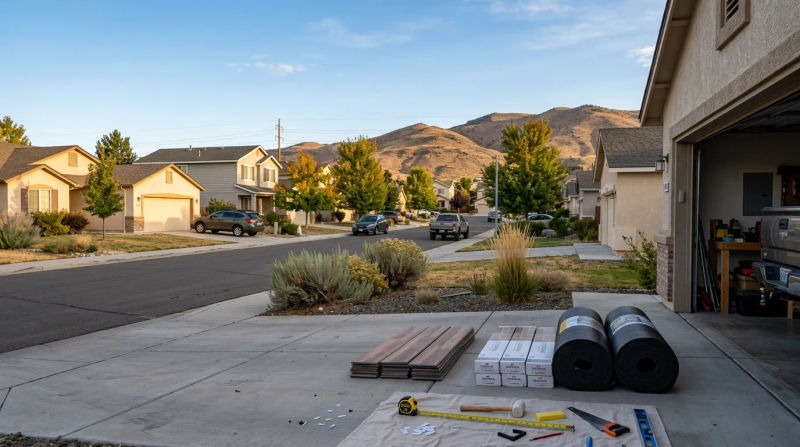
As a Senior Technician with Joe The Handyman, I've spent more than a decade working in homes all across Sparks and the Truckee Meadows. You get to know the rhythm of the seasons here, not just by the weather outside, but by the calls we receive. As the nights start cooling down in September, the phone rings with homeowners noticing new creaks, pops, and even visible gaps appearing in their flooring. This isn't a coincidence; it's a direct result of living in our unique high-desert climate.
Sparks is a fantastic place to live, but its environment is demanding on our homes, especially on materials like flooring. The dry air, significant temperature swings, and seasonal shifts in humidity create a set of challenges that you won't find in more temperate parts of the country. Choosing the right flooring here isn't just about color and style - it's about selecting a material and an installation process that can withstand these local pressures. That’s where local expertise becomes invaluable.
Sparks Weather Challenges
To understand which flooring works best, we first need to appreciate what it’s up against. The biggest culprits in our region are low humidity and dramatic temperature fluctuations.
- Extremely Dry Air: Northern Nevada is arid. This dry air naturally pulls moisture out of everything inside our homes, including wood-based flooring. When solid hardwood loses moisture, it shrinks. This shrinkage is what causes those unsightly gaps between planks that often appear in the fall and winter when the heating is on and indoor air is at its driest.
- Temperature Swings: It's not uncommon for a 30- or 40-degree temperature difference between our daily highs and nightly lows. All materials expand when heated and contract when cooled. Your flooring is no exception. This constant movement, day in and day out, puts stress on the planks and the installation system.
- Seasonal Humidity Shifts: While our air is generally dry, the indoor relative humidity can swing significantly. Summer monsoonal moisture might briefly raise humidity, while winter heating can plummet it. A floor that was installed perfectly in a more humid month can start to show problems as the environment changes. At Joe The Handyman, we see this often in Sparks; a beautiful new floor can quickly develop issues if it wasn't chosen and installed with these swings in mind.
These factors combined mean that flooring materials that perform well elsewhere can fail prematurely here. We've seen cupping (where the edges of a plank are higher than the center), crowning (the opposite of cupping), and excessive gapping in floors that simply weren't suited for our climate.
Best Practices for Local Homeowners
So, how do you choose a floor that will look great for years to come? It comes down to selecting the right material and insisting on proper installation techniques. Our technicians have found that certain types of flooring consistently outperform others in the Truckee Meadows.
When it comes to LVP vs laminate mountain climates, there are clear winners. Luxury Vinyl Plank (LVP) is often our top recommendation. It's a synthetic material, so it's not susceptible to moisture changes the way wood is. It's incredibly stable and durable, making it a fantastic choice for busy households. Modern LVP offers incredibly realistic wood and stone looks, so you don't have to sacrifice aesthetics for performance.
Another excellent option is engineered hardwood in dry climate conditions like ours. Unlike solid hardwood, which is one piece of wood, engineered planks are made of a top layer of real hardwood bonded to multiple layers of plywood or high-density fiberboard. This cross-layered construction gives it dimensional stability, making it far more resistant to shrinking and expanding than its solid counterpart. It gives you the authentic look and feel of wood without the high risk of gapping.
This is particularly relevant for homes in neighborhoods like Washoe Valley. Many of these beautiful, large homes were built in the 1990s and 2000s and feature the open-concept, Neo-eclectic style of that era. When we are tasked with replacing flooring across these large, continuous spaces, using a dimensionally stable product like high-quality engineered hardwood or LVP is critical to ensure a uniform, lasting finish.
Regardless of the material you choose, proper installation is non-negotiable. Two key factors are:
- Acclimation: The flooring material must be left in the room where it will be installed for several days before installation. This allows the material to adjust to your home's specific temperature and humidity conditions. Skipping this step is a recipe for failure.
- Expansion Gaps: This is one of the most important aspects of flooring expansion gaps Nevada. A small gap (typically hidden by baseboards and trim) must be left around the perimeter of the room. This space gives the floor room to expand and contract naturally with temperature changes without buckling or putting stress on the planks. The team at Joe The Handyman recommends a careful calculation of this gap based on the material type and the size of the room.
Local Resources and References
While Sparks doesn't have a specific building code dictating flooring types, every manufacturer provides a specification sheet for their products. This document is your most important local resource. It will list the acceptable temperature and humidity ranges for the material. I always advise homeowners to check these specs and compare them to the conditions in their own homes.
A simple and inexpensive tool every Sparks homeowner should have is a hygrometer. This device measures the relative humidity inside your home. Knowing your home's baseline and seasonal humidity range can help you and your technician choose the perfect flooring material. If your home is exceptionally dry, it might point you towards LVP or inform the need for a whole-home humidifier if you're set on a wood product.
Our trained crews are equipped to assess these environmental factors during an on-site consultation. We can help you understand your home's unique conditions and what they mean for your flooring choices.
Choosing a Local Expert
When you invest in new flooring, you're not just buying a product; you're buying the installation and the expertise behind it. This is where choosing a local professional makes all the difference. A contractor unfamiliar with our high-desert climate might use installation techniques that work fine in California or Oregon but will fail here within a year or two.
Joe The Handyman has served Sparks homeowners for years, and we've built our processes around the specific challenges of this region. Our technicians understand the importance of subfloor preparation, proper acclimation, and precise expansion gaps. We have standardized workflows that ensure every job is done to the highest standard, delivering a finished product that is built to last in our environment.
In my 12 years as a technician here, I've seen firsthand what happens when shortcuts are taken. A beautiful, expensive floor can be ruined by a poor installation. We pride ourselves on our reliability, our deep knowledge of local building conditions, and our commitment to doing the job right the first time. We're not just installers; we're local maintenance and repair experts who understand how a house performs as a complete system.
Choosing the best flooring Sparks NV has to offer means partnering with a team that understands the area inside and out. It's about ensuring your investment is protected by quality craftsmanship and local knowledge.
When you’re ready to upgrade your floors, you need a team that understands the unique demands of our Sparks climate. The team at Joe The Handyman combines years of local experience with professional, standardized processes to deliver a floor that is not only beautiful but also durable enough for our high-desert homes. For a consultation and to discuss the best flooring solution for you, reach out to us today.